

Storm Austen opened the week, Storm Boelo closed it with gusts of up to 80 mph, and another wind warning is already out. Storm season has arrived. If you have a household wind turbine, two questions come with it: how much power will it make, and will it be safe?
Two storms in one week
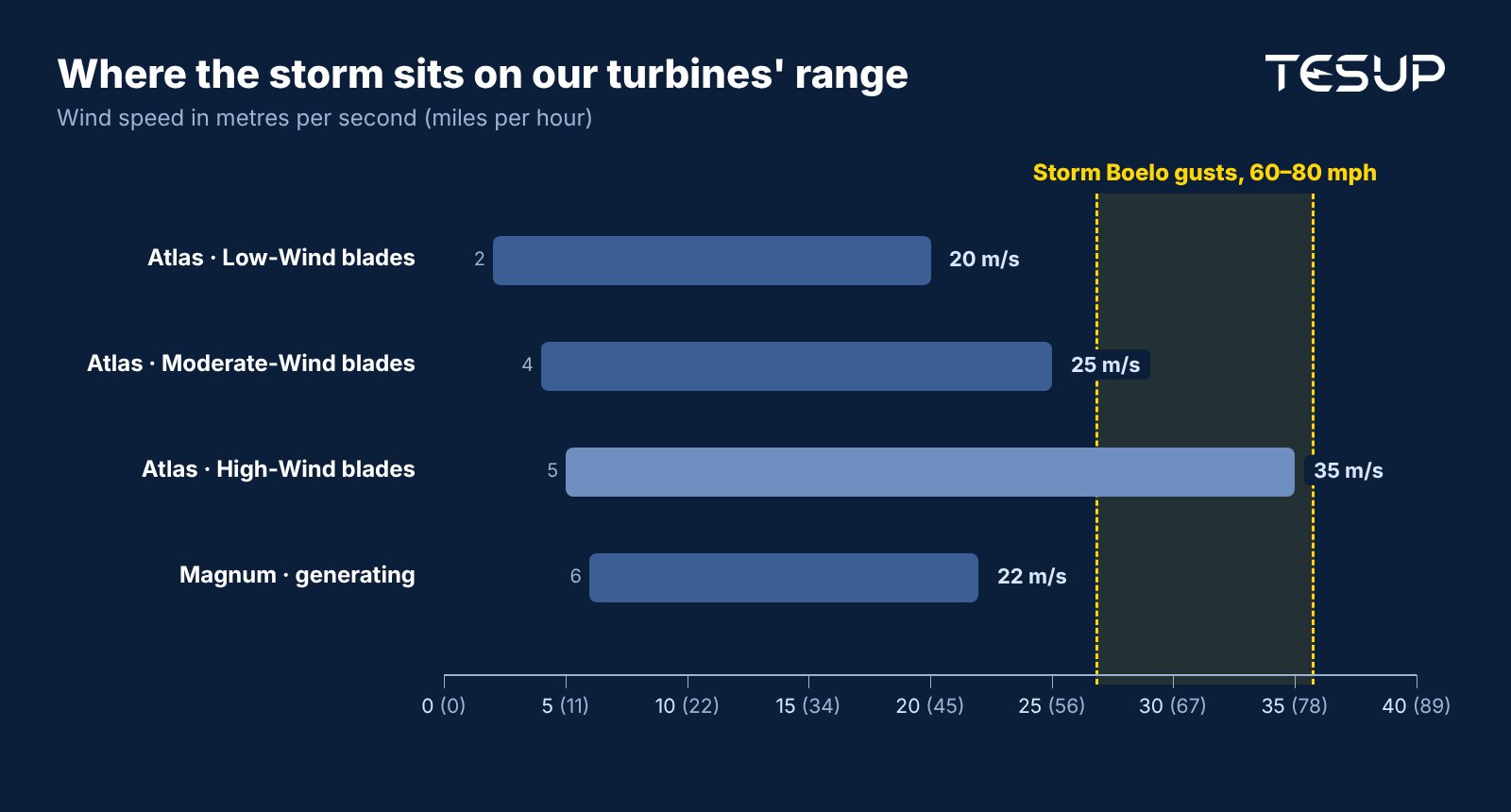
Storm Austen was named on 20 October and brought yellow wind warnings to South West England, South Wales and the south coast. Storm Boelo followed at the weekend, with amber warnings for Scotland, parts of Northern Ireland and northern England, widespread gusts of 60 to 70 mph and up to 80 mph on exposed coasts. In wind-speed terms, that is about 27 to 36 metres per second.
Zoom out and October looks even busier. Hurricane Isaias made landfall near Destin, Florida, on 9 October with winds of 105 mph. Its remnants then fed a new low that deepened rapidly near Iceland on 14 October, with gusts of about 128 mph. Storm Adam brought floods to eastern Spain, and Storm Austen went on to hit Brittany with gusts of 100 mph before crossing into Germany.

Where the storm sits on our turbines' range
Every turbine is built for a range of wind. Atlas, our vertical-axis turbine, takes one of three swappable blade sets: Low-Wind for 2 to 20 m/s, Moderate-Wind for 4 to 25 m/s and High-Wind for 5 to 35 m/s. The High-Wind set has six smaller blades and is made for storm-prone coastal sites, so it covers gusts of up to about 78 mph. Magnum, our three-blade horizontal turbine, starts generating at 6 m/s and keeps climbing to its peak at 22 m/s.
Windy days are the best days
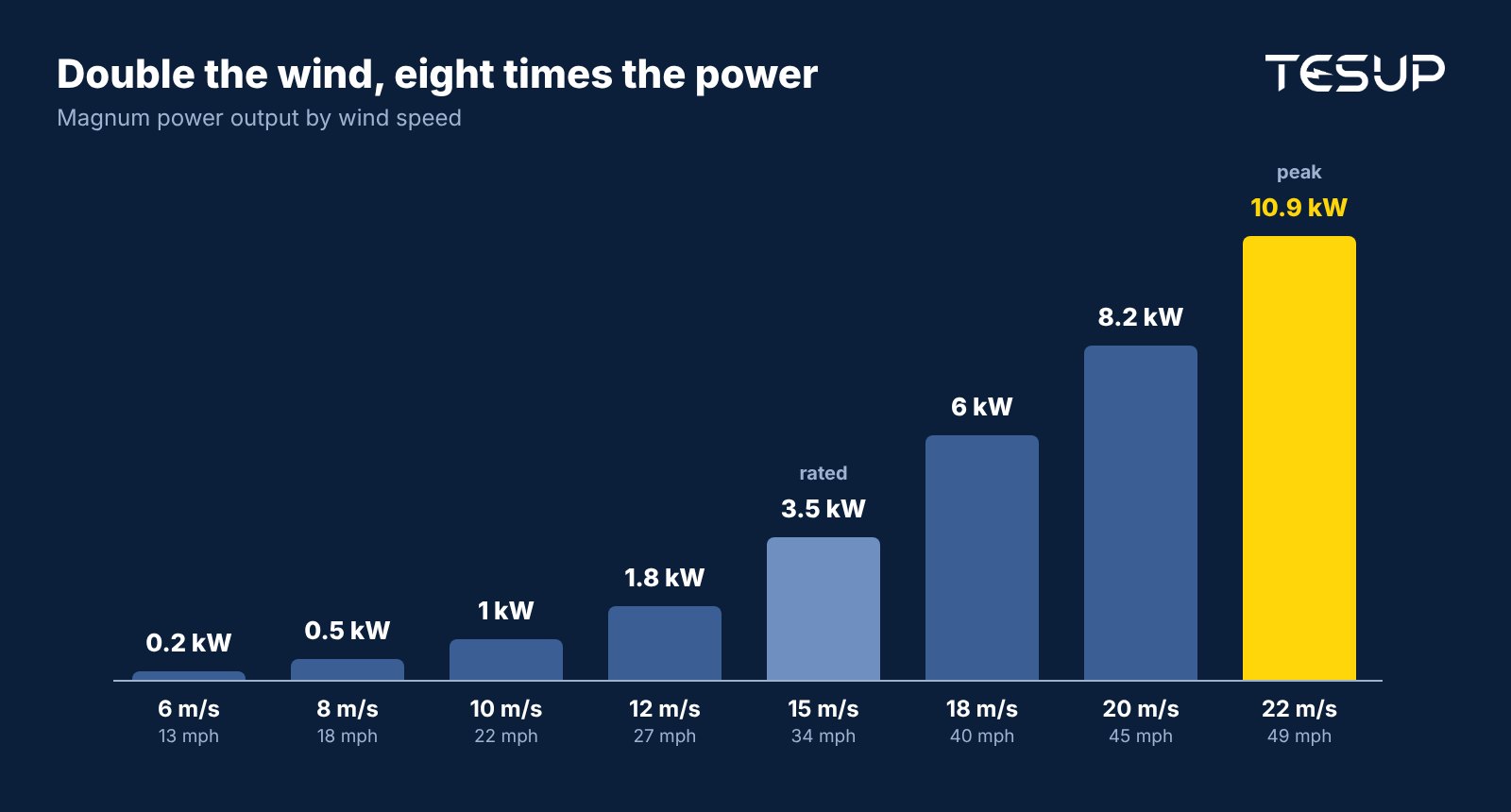
Strong wind is when a turbine earns its keep. Magnum makes 1 kW at 10 m/s, 3.5 kW at its rated 15 m/s and 10.9 kW at 22 m/s. Power rises steeply with wind speed: double the wind from 10 to 20 m/s and Magnum's output grows about eight times, from 1 kW to 8.2 kW. One stormy afternoon can make more electricity than a whole calm week.
How Atlas and Magnum protect themselves
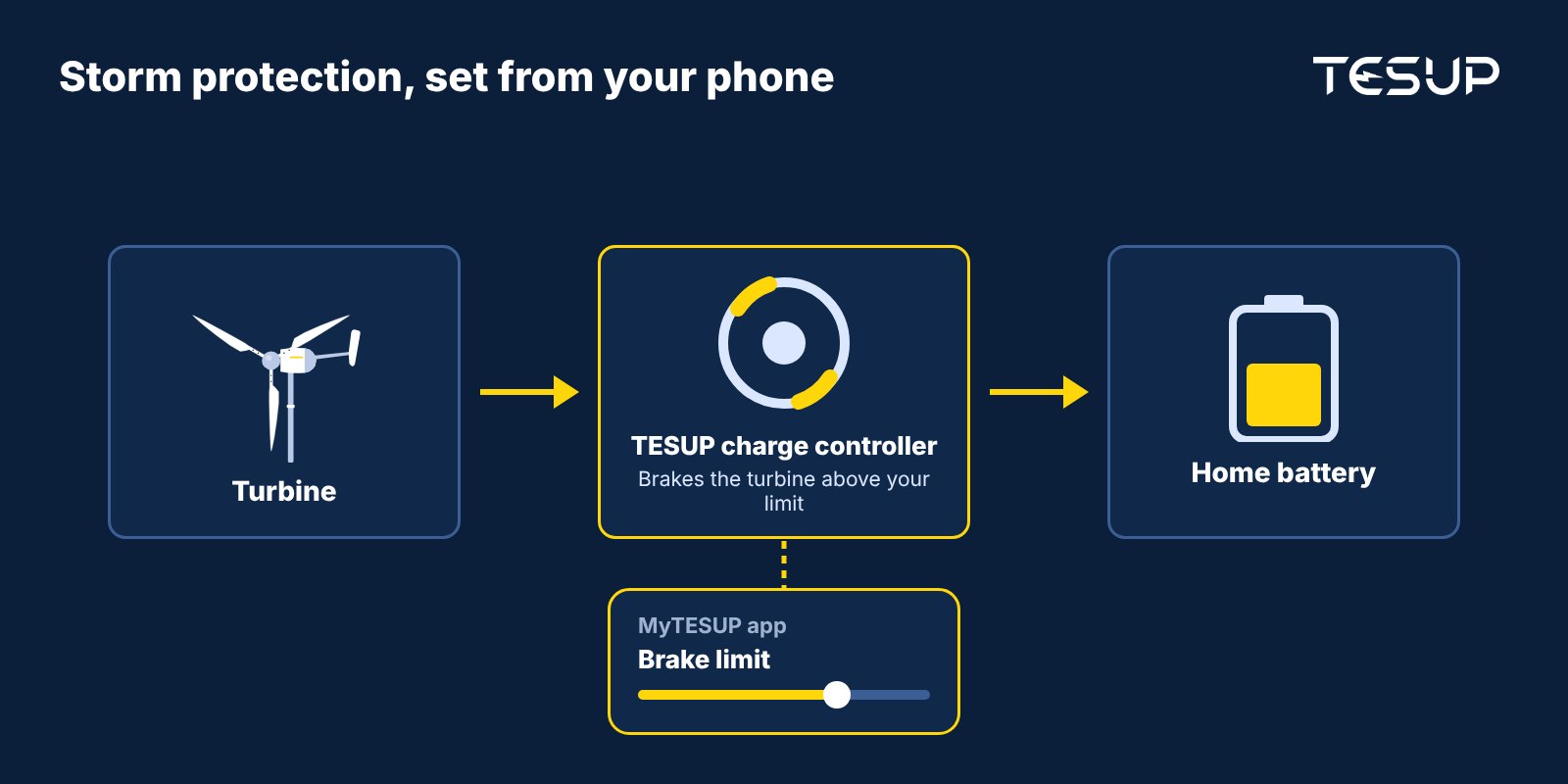
Both turbines use the same motor, rated for 15 kW continuous and 22 kW peak. Atlas typically delivers about 1 kW and Magnum up to 10.9 kW, so the motor always has headroom when a gust hits. With a TESUP charge controller, there is a second layer: the controller brakes the turbine automatically when its output goes above the limit you choose, in the MyTESUP app or on the controller itself. It is storm protection you can set from your phone.
Five things to check before the next gale
- Set your brake limit in the MyTESUP app before the storm arrives.
- If your Atlas has Low-Wind blades and the forecast shows sustained winds above 20 m/s, take them off or switch to Moderate-Wind or High-Wind blades.
- Check that the mounting bolts and brackets are tight.
- Secure loose cables so they cannot whip in the wind.
- After the storm, take a look and listen. If anything looks or sounds different, contact our support team.
Make the storms work for you
More named storms will come before spring. With the right blade set and your brake limit in place, every gale becomes free power for your home. Not sure which turbine or blades suit your site? Our team will help you choose.
Storm details: Met Office, October 2026. Turbine figures: TESUP product data. Wind speeds converted at 1 m/s = 2.24 mph.
Ready for the windy season?
Atlas catches wind from any direction, with a blade set for every site. Magnum is made for open, steady wind.
Explore AtlasExplore Magnum