


A pallet of turbines is leaving Slovakia for Germany. Two countries, one truck, and — because both are in the European Union — no customs frontier in between. That last part is unglamorous and it is one of the few things about buying hardware that genuinely changes depending on where it ships from.
Slovakia to Germany, without a border stop.
Slovakia and Germany are both EU member states, which means they are inside the same customs union and the same Schengen area. Goods already in free circulation move between them the way they move between two counties: no customs declaration to file, no import duty to pay, no clearance to wait on. The truck does not stop at a barrier because there is no barrier to stop at.
Compare that with a consignment arriving from outside the union, where somebody has to file an entry, a duty may be assessed against a tariff code, and the pallet can sit in a shed until the paperwork clears. None of those steps is dramatic on its own. Together they are the difference between a delivery date you can plan around and one that depends on an office you have never spoken to.
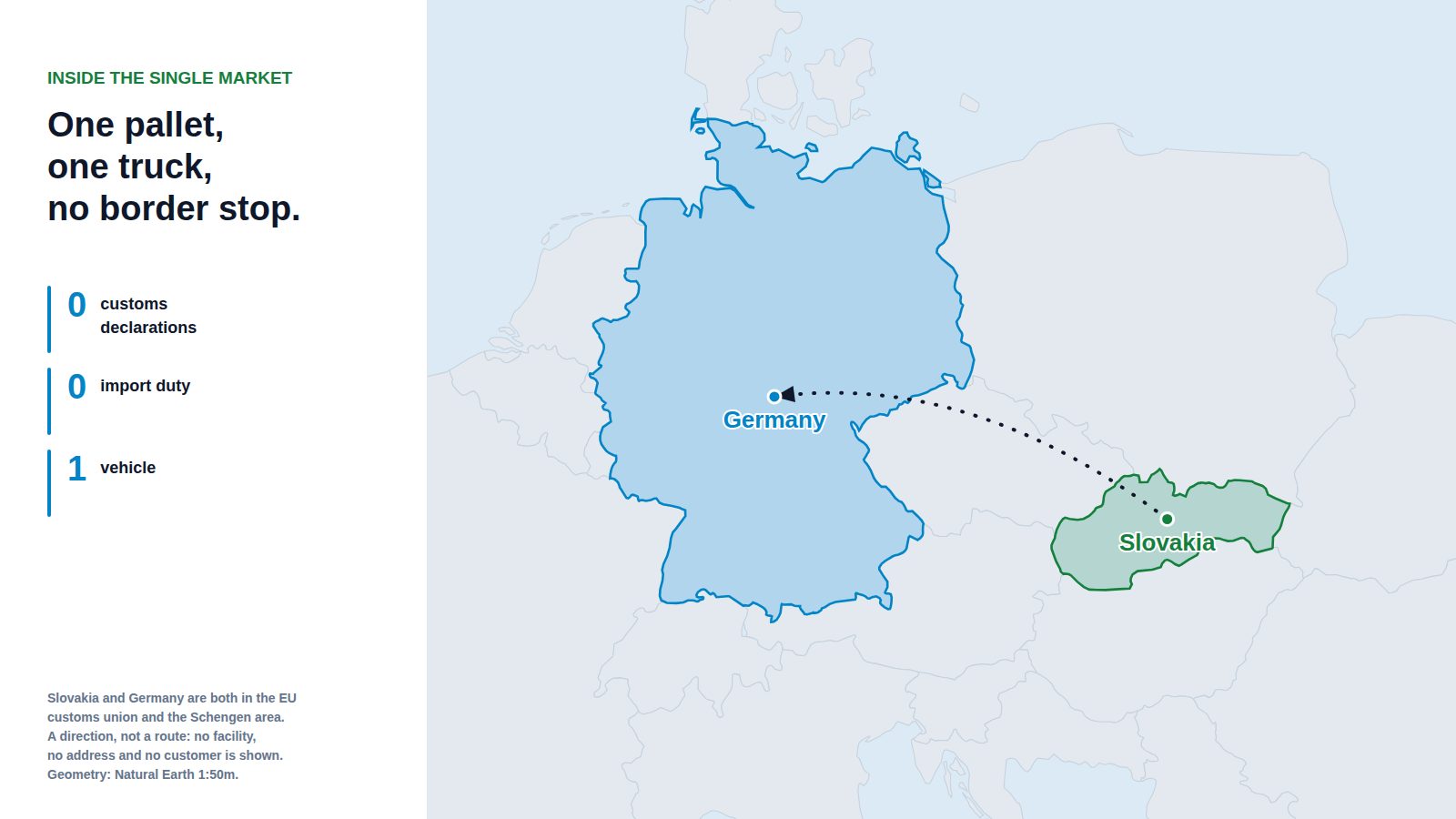
A direction, not a route. We know which two countries this pallet moves between and nothing else is ours to publish.
One thing worth separating out: customs and VAT are not the same question. There is no tax collected at the frontier on an intra-EU movement, but who ultimately accounts for VAT depends on whether the buyer is a business with a valid registration or a private individual, and on which country they are in. That is a question for your own accountant rather than a claim we are going to make on a blog.
The symbols speak no language, on purpose.
Printed on the top cartons are four pictograms: a broken wine glass, a pair of upward arrows, a box held in two hands, and an umbrella. Fragile, this way up, handle with care, keep dry. There is no text with any of them, and that is deliberate — they are the international handling marks, drawn the same way everywhere, so that a person loading a trailer understands them without knowing a word of the language on the box.
It is a small thing that tells you something about how freight actually works. Between our workshop and a German delivery address, this pallet will be handled by people who never speak to each other and may share no common language. Nothing about the box can rely on a conversation. Everything it needs to communicate has to be printed on it in a form that survives being handled by a stranger at three in the morning.
A shipping carton is a set of instructions to somebody you will never meet.
A label on every single box.
Every carton on the stack carries its own white label with a QR code, not one label for the pallet. That costs more to print and more to apply, and it is worth it for the same reason the serial number on a charge controller is worth it: the moment a pallet is broken down — and it always is, at a depot or at the far end — a box with no identity of its own becomes a box nobody can trace.
If one carton out of a stack goes missing or arrives damaged, we want to be able to say which one, from which batch, holding what. That is not possible if the only identification was on a shipping note stapled to the outside of the wrap.
What a pallet needs at the other end.
This is the part people are most often surprised by, so it is worth saying before delivery day rather than after. A loaded pallet is not a parcel. It arrives on a lorry, it comes off with a tail lift, and it needs firm level ground to be set down on and something with wheels to move it once it is there. A gravel drive, a flight of steps, or a narrow lane a rigid truck cannot turn into are all real problems, and all of them are much easier to solve a week early than on the morning.
So: check access before the pallet is booked, not when it is on the road. Tell us if the answer is awkward. A delivery that has to be attempted twice costs everybody more than a conversation beforehand, and we would rather have the conversation.
And what this page is not.
It is not a customer story. We are not naming who this pallet is going to, what town it is bound for, or what is on the invoice — not in Germany and not anywhere else. What is publishable is the route between two countries and what is printed on the outside of a box, which is all that appears here.
It is also not a promise about your own order. A pallet photographed on its way out is one pallet on its way out. Our product pages say plainly that delivery runs from as little as one day to as long as four months depending on stock, and a photograph of freight does not change that number in either direction.
No declaration, no duty, no border stop.
Just a stack of boxes, a wrapped pallet, and a drive across two countries.
Slovakia and Germany are both member states of the European Union and of the Schengen area, so goods in free circulation move between them without customs formalities; that is a matter of public law rather than a claim about our own arrangements. Nothing here is tax advice, and a buyer’s VAT position depends on their own status and country. The handling pictograms described are the standard international marks for fragile, this way up, handle with care and keep dry. The one-day-to-four-month delivery range is our own published figure from our product pages. The map shows two countries and a direction; it does not show a route, a facility or an address. No customer, order, address or installation is named, described or shown on this page.