

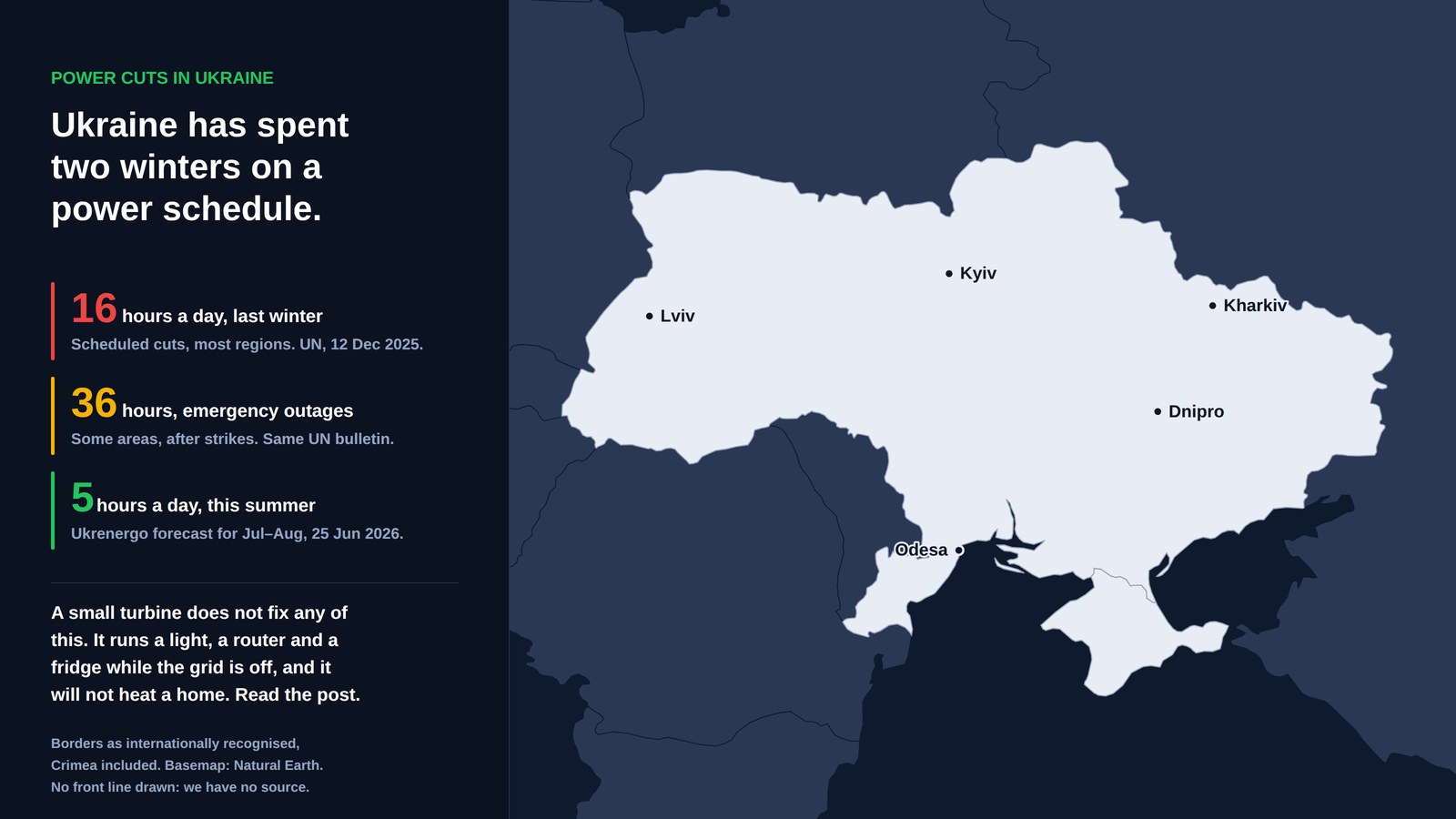
We sell wind turbines in Ukraine, and Ukraine has spent two winters on a power schedule. That combination makes it very easy to write something opportunistic, so this post is going to do the opposite: the limits first, the numbers with dates attached, and no customer’s story used to sell anything.
What a schedule actually is.
A blackout schedule is not a blackout. It is a timetable. Households are put into groups, and each group is told which hours it will have electricity and which hours it will not. When the grid is holding, the timetable is followed and you can plan around it — cook when the power is on, charge everything, fill containers with water. When the grid is hit, the timetable stops meaning anything and the outage becomes an emergency one, which is the kind you cannot plan around at all.
In December 2025 the UN’s human rights monitoring mission in Ukraine reported that most regions were facing scheduled rolling cuts of up to sixteen hours a day, and that after one series of strikes, emergency outages in some areas ran past thirty-six hours. This summer has been easier: in June, the head of Ukraine’s grid operator said the country could expect emergency cuts of up to about five hours a day through July and August. Both of those are real numbers from named sources, and neither of them is a forecast for the coming winter, which nobody can give honestly.
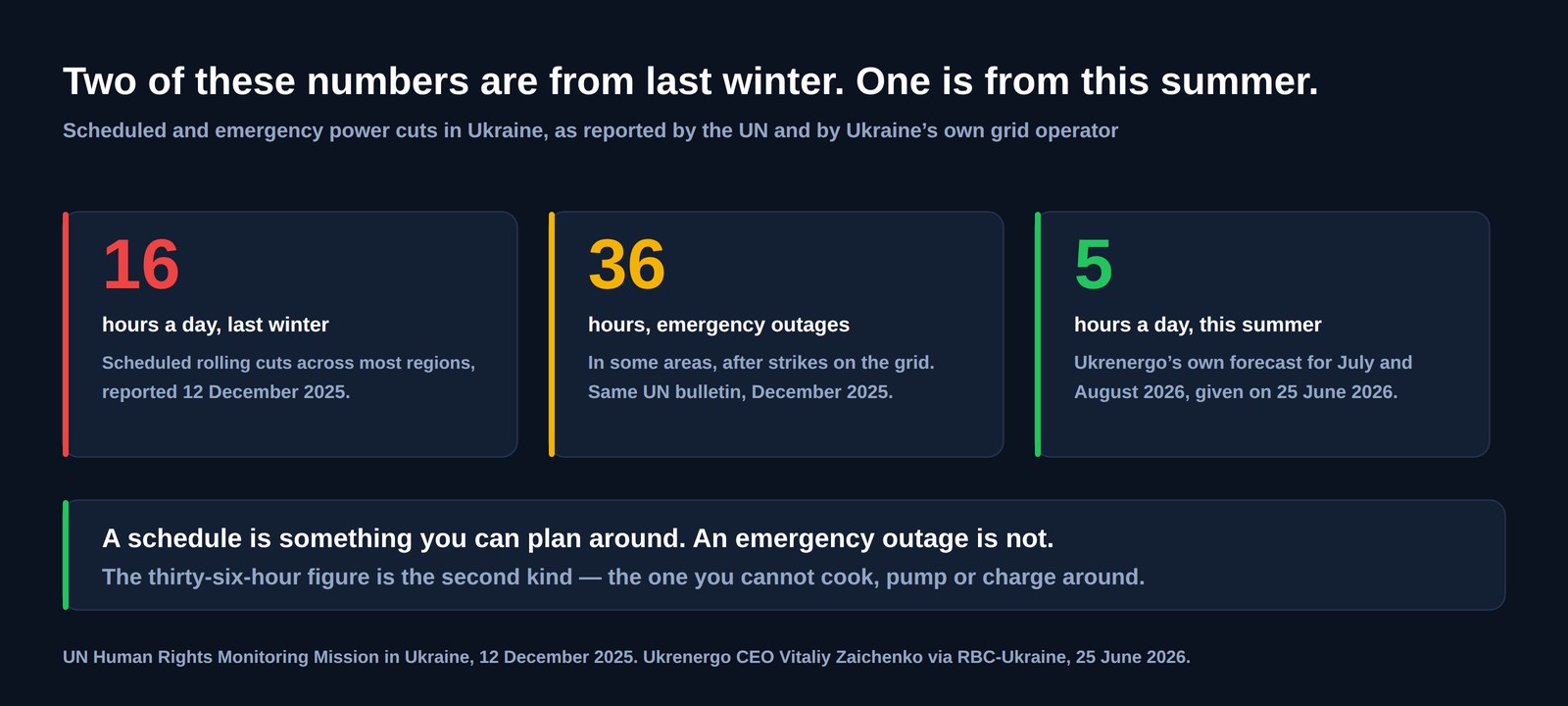
Each of the three figures with its source and its date attached, because presenting the winter numbers as current would be the easiest mistake in the whole piece.
What a small turbine will not do.
This section comes before the other one deliberately. A roof-mounted turbine is a few hundred watts to a few kilowatts in good wind. That is not a generator, and treating it as one gets people hurt.
It will not heat a home. Electric heating is measured in kilowatts held for hours, and no small wind turbine on a domestic roof will carry that in winter. It will not run an electric cooker, an immersion heater or a washing machine at will. It is not a substitute for a hospital, clinic or shelter generator, and anyone specifying power for those should be talking to a diesel supplier, not to us. It also cannot be relied on to produce on any particular day: wind is not a schedule either, and there are calm weeks in winter.
And there is a practical limit that has nothing to do with electricity. Most people living under a schedule live in apartment blocks, where the roof is not theirs, the mounting is not theirs to decide, and a mast on a residential building is a structural and legal question before it is an energy one. This is realistically a thing for houses, not for flats.
A second source does not fix a grid. It changes what a household can still do while the grid is down.
What it will do.
The useful shape is not turbine-to-appliance. It is turbine-to-battery, and battery-to-the-few-things-that-matter. A small wind turbine trickling into a battery bank over a long windy night is doing something a solar panel cannot do at that hour: it is refilling the store while everyone is asleep and the grid is off.
What that store then runs is the modest list: lights, phones and a router, a water pump, a fridge cycling on and off, a laptop, and the charger for whatever else the household depends on. None of that is impressive on a specification sheet. All of it is the difference between an evening that works and an evening that does not.

The wiring is the whole argument. The same turbine is a disappointment on the top row and quietly useful on the bottom one.
Why wind, specifically, in winter.
This is the one argument that genuinely transfers, and it is worth stating precisely rather than generously. Solar has a season; wind mostly does not. In a typical year at Kyiv the December sun delivers about eight per cent of what the July sun delivers, while the wind’s own quietest month is July and even that carries about a third of the energy of its windiest. Wind is not at its best in midwinter — March is windier — but it does not collapse in midwinter either, and sunlight does. A household running on one source has a bad month. A household running on two sources has a bad week, because the two do not fail at the same time.

Checked rather than asserted. February is a genuinely calm month at Kyiv and the chart shows that too, which is the point of drawing it from data instead of from the argument we wanted to make.
That is the same point made in every other post on this blog, and it is not a Ukraine argument at all. It just matters more where the grid is being attacked than where it is merely expensive.
What we are not going to do.
We are not going to publish a customer’s story. We have orders from Ukraine, and every one of them comes with a name, a street and a town attached. Publishing that a particular address has an independent power source is not a testimonial, it is targeting information, and no amount of goodwill makes it safe. Nobody will be named here, ever.
We are not going to run a countdown, a war-themed discount or an urgency campaign. And we are not going to tell you a turbine keeps anybody safe. It runs a light and a router for a few hours. That is worth having and it is not worth exaggerating.
If you are in Ukraine and want to work out whether any of this applies to your building, the useful thing to send us is your situation — house or flat, roof or ground, what you actually need to keep running — and we will tell you honestly if the answer is no. It often is.
The honest version of this is small and dull: a second source, a battery, and a shorter list of things that stop working.
Anyone selling you more than that, on this subject, is selling you something else.
The sixteen-hour and thirty-six-hour figures are from the UN Human Rights Monitoring Mission in Ukraine, published 12 December 2025, and describe last winter rather than the present day. The five-hour figure for July and August 2026 is from Vitaliy Zaichenko, chief executive of Ukrenergo, in an interview with RBC-Ukraine published 25 June 2026. We have given no forecast for the coming winter because we have no basis for one. No customer is named here, no order is described, and no location of any installation is published. The map at the top shows Ukraine’s internationally recognised borders, Crimea included; the public-domain Natural Earth basemap we drew it from does not, so we corrected it, and we say so rather than leave a border quietly redrawn either way. It shows no front line, because we have no source for one worth putting on a page. The monthly sun-and-wind chart is built from the European Commission Joint Research Centre’s PVGIS v5.2 typical meteorological year for Kyiv, with radiation from PVGIS-SARAH2 and wind from ERA5, drawn from 2005 to 2020; wind is plotted as the mean cube of the ten-metre wind speed, which is the energy available in the wind and not the output of any particular turbine, and a typical year composes each month from a different real year. Turbine output depends entirely on the wind at your own site and the figures on our product pages are our own published data.