


Before an Atlas body is boxed, it goes on a scale. This one read 22.30 kg. It is not a flattering number to lead with — heavier always sounds worse — but it is the first thing anyone who actually has to mount a turbine needs to know, and it is usually the hardest thing to find on a spec sheet.
The Atlas body is the part that does the work. The generator, the smart charge controller, the display and every connector sit inside one sealed aluminium housing built for permanent outdoor life. There is no separate control box to find a wall for, and no second enclosure to weatherproof. That is why the figure is what it is: nearly the whole electrical system of a wind turbine, in a single piece you can lift.
What 22.3 kg does not include
The blades. The pole or the mast. The mounting hardware. The Atlas takes swappable blade sets, and which set you choose changes the total. So please do not size a roof bracket or a mast on 22.3 kg — that is the body alone. Your structure has to carry the whole assembly, plus every load the wind puts through it, on the worst day of the year rather than an average one.
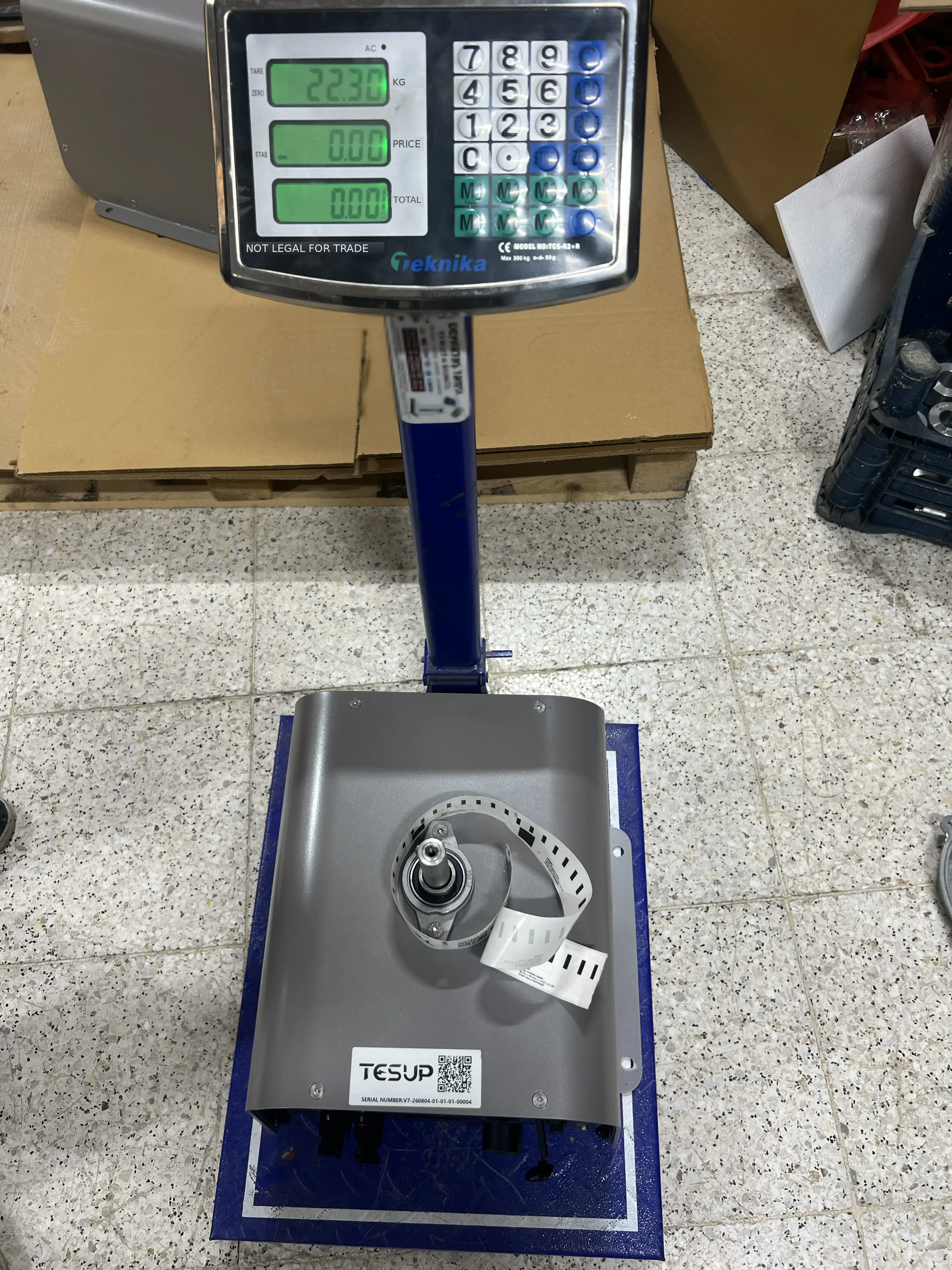
One Atlas body on the workshop scale. The reading is 22.30 kg.
Output figures sell turbines. Weight decides where you are allowed to put one.
Why the weight is the first real constraint
Ask a prospective owner about a turbine and they ask about kilowatts. Ask the person who has to fix it to a building and they ask about kilograms, then about where the load lands, then about wind class. A rated output is a promise about good conditions. A weight is a fact your rafters have to live with in every condition, for years.
This is also why we would rather publish the number than be asked for it. If 22.3 kg plus blades is too much for the structure you had in mind, that is far better discovered now than after delivery.
About the scale, because the number should be checkable
It is a Teknika TCS-K2+R platform scale: 300 kg maximum, with a division of 50 grams. So it resolves to the nearest 0.05 kg, and 22.30 is a clean multiple of that. You can read the panel in the photograph above, including the line that says it is not a certified trade instrument. It is a workshop scale, which is exactly what it looks like.
That is why we write about 22.3 kg rather than implying laboratory precision. It is accurate enough to size a mount and honest about its own limits, which is the most any single measurement can offer.
The same unit, turned through every face — watch it on YouTube.
And measure your wind before you buy anything
Weight is the constraint you can check with a tape measure and a structural opinion. Wind is the one nobody can check for you. Two houses on the same street can differ by a factor of two, so any annual output figure we quote is a guess about your roof — and a guess we have an obvious interest in.
So measure first. An anemometer costs a small fraction of a turbine and will tell you within a season whether your site is worth it. Then put your own numbers into the calculator on the Atlas and Magnum pages — your wind, your electricity price, your roof. It will tell some of you that a turbine will not pay for itself where you live, and we would rather it told you that now.
Twenty-two and a bit kilograms is a small fact. But it is the fact that decides whether an installation is a morning's work or a conversation with a structural engineer — and you should have it before you spend anything, not after the pallet arrives.