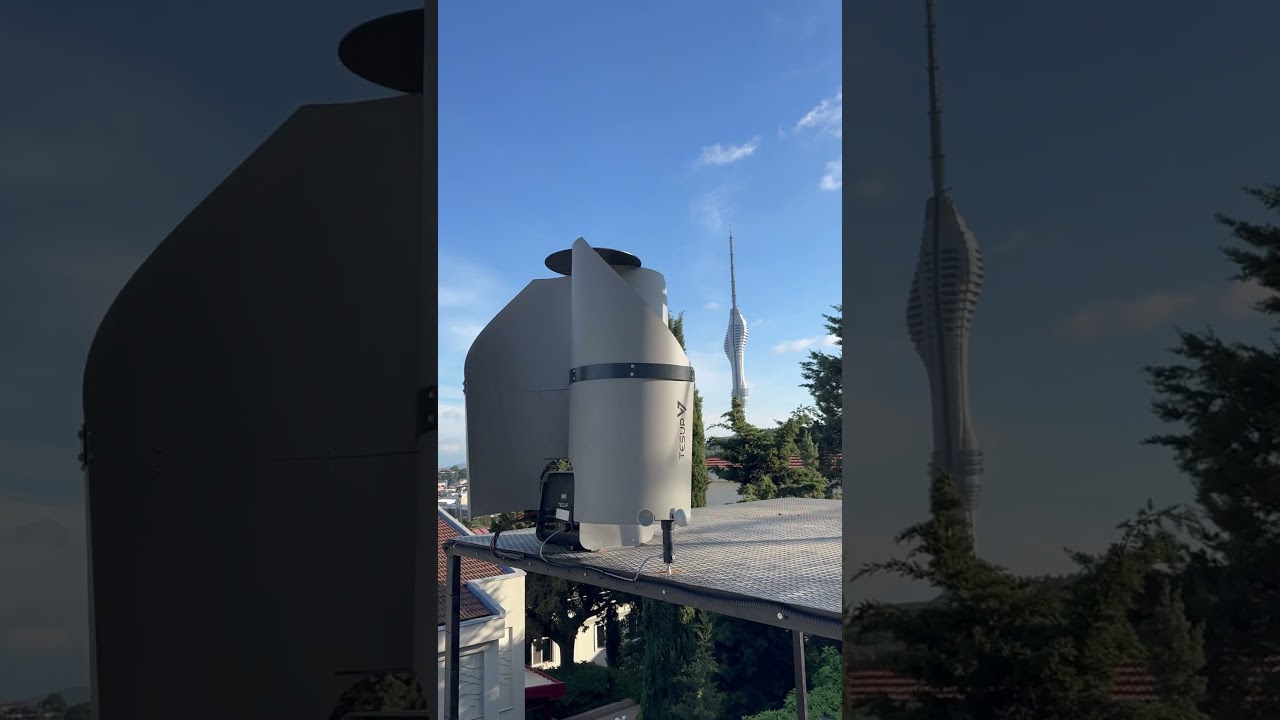
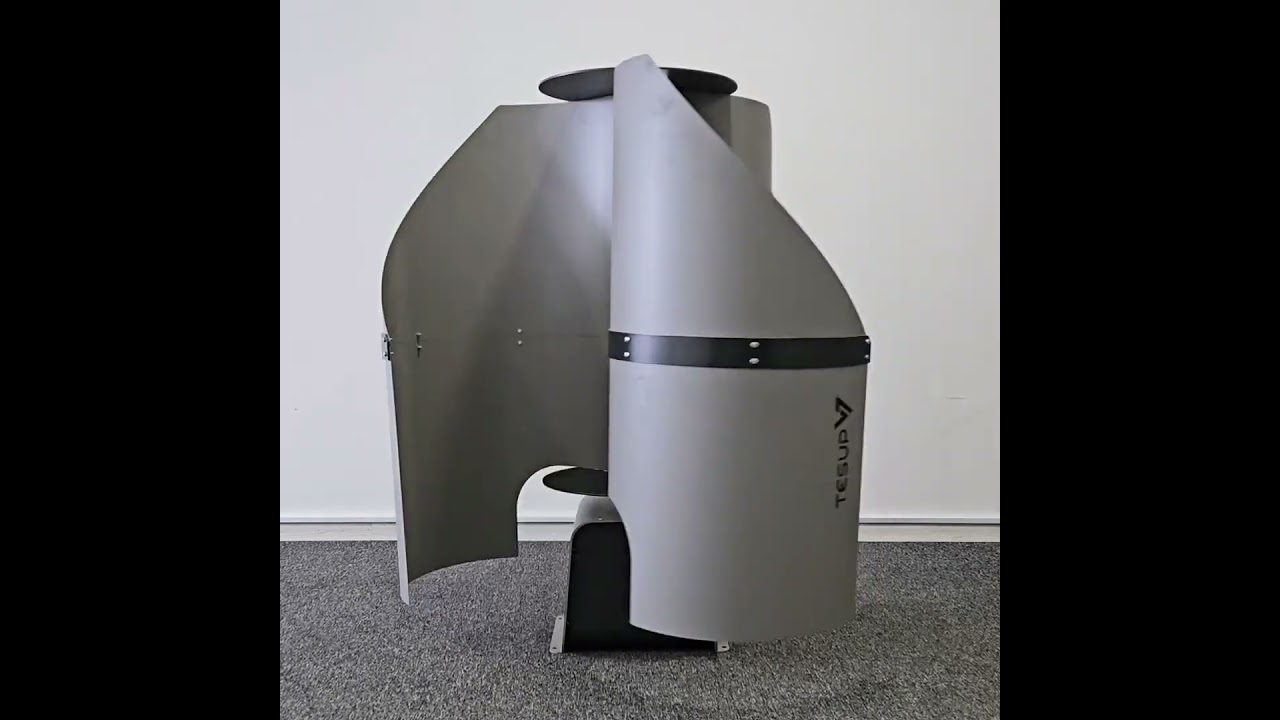
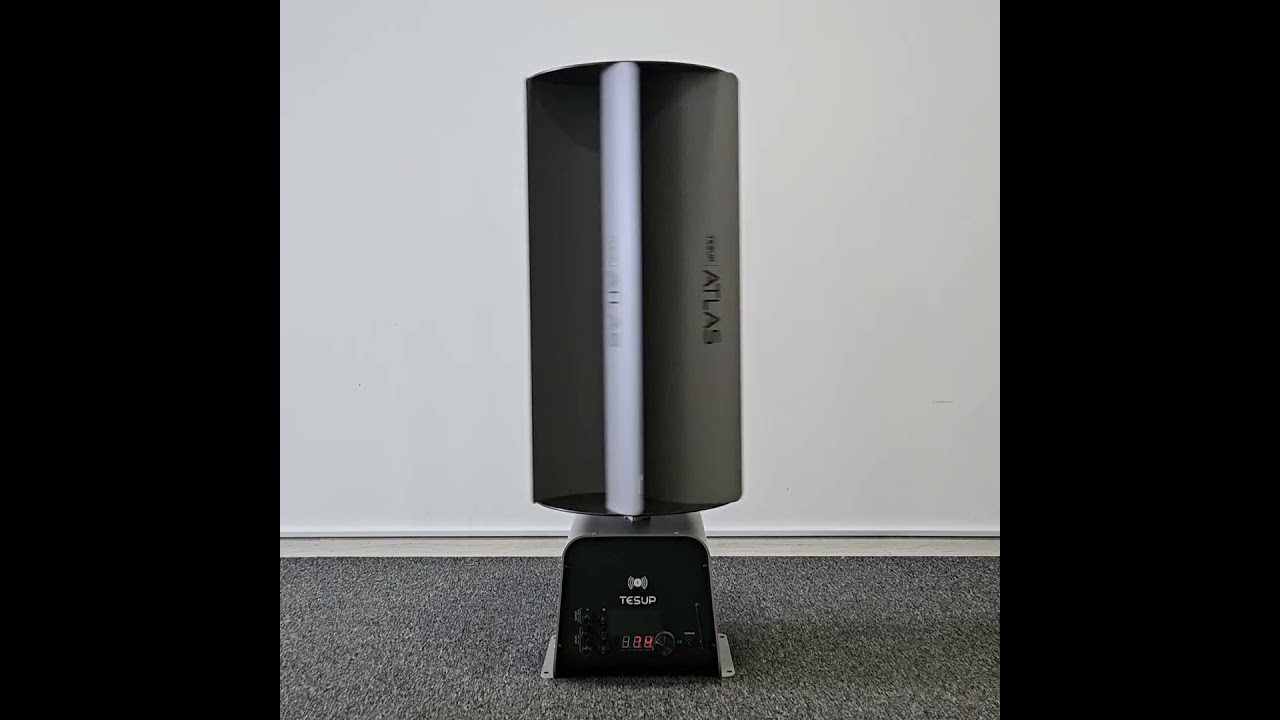
Meet ATLAS — the world's best-selling vertical wind turbine, capable of generating power even by hand. Trusted at Arctic research centres, on California homes, and aboard Maersk and MSC fleet ships — wherever the wind is gusty, turbulent, or shifts direction.
This purchase includes the generator with built-in IoT charge controller. Blade set sold separately — three options for your site's wind profile.
Power & Performance
4.5 kW peak system output with High-Wind blades — 3.8 kW with Moderate-Wind, 2 kW with Low-Wind
Easy 1 kW at just 13 m/s (Low-Wind blades) — far below the threshold of horizontal turbines
Starts at 2 m/s — one-third the cut-in of horizontal turbines
Annual yield: 180–3,500 kWh depending on average wind and chosen blade set
Noise: 35–40 dB — quieter than a conversation
Built-in IoT charge controller — voltage limit 0–400 V (set via MyTESUP app or potentiometer); monitors power, wind, solar data
Three blade sets — engineered for survival, not just performance
Most small wind turbines have one blade set and a hard structural ceiling. Atlas ships with three optimised, swappable blade sets — each laser-cut from 1.2 mm high-strength aluminium, structurally tested to survive sustained operation at the upper limit of its design range:
Low-Wind blades (2–20 m/s, 2 kW peak): aerodynamic, low-solidity profile for fast self-start. Begin generating at 2 m/s — three times lower cut-in than typical horizontal turbines. Most common residential choice.
Moderate-Wind blades (4–25 m/s, 3.8 kW peak): reinforced airfoil with optimised stall characteristics. Independent field research shows exceptional energy production in the 10–25 m/s range — sweet spot for windy inland and hilltop sites. Survives sustained 25 m/s without structural fatigue.
High-Wind blades (5–35 m/s, 4.5 kW peak): 6-blade configuration with reduced swept area and reinforced root attachment. Designed for coastal cliffs, exposed ridges, storm-prone sites. Remains intact and continues generating at sustained 35 m/s — most competing small turbines tear apart at half that speed.
In stock
SKU
atlas_body_nz
Made to Order — Built Specifically for You
Atlas S67. Built once. 25 years of power.
Meet ATLAS — the world's best-selling vertical wind turbine, capable of generating power even by hand. Trusted at Arctic research centres, on California homes, and aboard Maersk and MSC fleet ships — wherever the wind is gusty, turbulent, or shifts direction.
This purchase includes the generator with built-in IoT charge controller. Blade set sold separately — three options for your site's wind profile.
Power & Performance
4.5 kW peak system output with High-Wind blades — 3.8 kW with Moderate-Wind, 2 kW with Low-Wind
Easy 1 kW at just 13 m/s (Low-Wind blades) — far below the threshold of horizontal turbines
Starts at 2 m/s — one-third the cut-in of horizontal turbines
Annual yield: 180–3,500 kWh depending on average wind and chosen blade set
Noise: 35–40 dB — quieter than a conversation
Built-in IoT charge controller — voltage limit 0–400 V (set via MyTESUP app or potentiometer); monitors power, wind, solar data
Three blade sets — engineered for survival, not just performance
Most small wind turbines have one blade set and a hard structural ceiling. Atlas ships with three optimised, swappable blade sets — each laser-cut from 1.2 mm high-strength aluminium, structurally tested to survive sustained operation at the upper limit of its design range:
Low-Wind blades (2–20 m/s, 2 kW peak): aerodynamic, low-solidity profile for fast self-start. Begin generating at 2 m/s — three times lower cut-in than typical horizontal turbines. Most common residential choice.
Moderate-Wind blades (4–25 m/s, 3.8 kW peak): reinforced airfoil with optimised stall characteristics. Independent field research shows exceptional energy production in the 10–25 m/s range — sweet spot for windy inland and hilltop sites. Survives sustained 25 m/s without structural fatigue.
High-Wind blades (5–35 m/s, 4.5 kW peak): 6-blade configuration with reduced swept area and reinforced root attachment. Designed for coastal cliffs, exposed ridges, storm-prone sites. Remains intact and continues generating at sustained 35 m/s — most competing small turbines tear apart at half that speed.
Made to Order — Built Specifically for You
Add-Ons for Enhanced Experience
Inside the Atlas — Industrial-Grade Engineering
Atlas uses the same premium 15 kW continuous-rated motor as the Magnum. At typical 1 kW output the motor runs at less than 7% load — cold-running, near-zero copper losses, service life exceeding 30 years.
12-pole, 36-slot, 3-phase distributed stator winding — fractional-slot configuration for minimal cogging torque and sinusoidal voltage output
90 wires per stator slot — 2 parallel strands × 45 turns of 0.70 mm Class 200°C enamelled copper (IEC 60317-13 GR 2), the insulation grade used in industrial servomotors and EV drivetrains
Parallel-strand bundling doubles current capacity and distributes heat across multiple thin conductors — motor runs cold even at sustained full load
4 kg of pure copper total winding mass — exceptional thermal reservoir
24-magnet rotor with NdFeB N42 super magnets, bread-shape (~60×25×5 mm, nickel-coated), 180 cm³ total magnet volume
±0.05 mm precision tolerances across all machined components
Silicon-steel laminated stator core — 240 individual 0.5 mm electrical-steel sheets stacked to 12 cm total height, ~16 cm outer diameter. Transformer/motor-grade construction that minimises eddy current losses
3 blades at 120° arranged in a bowed Darrieus profile — significantly higher Cp than two-blade designs
Effective swept area ~2.0 m² — bowed-blade envelope with 1.0 m rotor height
Aluminium blades — 65% lighter than steel for instant low-wind response, corrosion-proof, lifetime maintenance-free
What is "swept area" — and why Atlas catches more wind than its rotor diameter suggests
Swept area is the cross-section of moving air the rotor intercepts. Power output scales linearly with swept area. Atlas's nominal dimensions: Ø 1030 mm × 1005 mm tall. A flat 2-blade design would give a rectangular envelope of just 1.04 m². But Atlas uses 3 blades at 120° in a bowed Darrieus profile — each blade curves outward at the middle and back inward at top and bottom. As the rotor spins this sweeps a curved envelope of ~2.0 m² effective area, plus a higher Cp from the 3-blade geometry — meaningfully more wind energy at every speed than a 2-blade flat rotor of the same diameter.
How power is calculated
Wind power: P = ½ × ρ × A × V³ × Cp × η. Wind speed (V) is cubed — small increases produce dramatic output gains. Atlas's bowed 3-blade geometry reaches Cp up to 0.45 with Moderate-Wind blades (top of the vertical-axis range) combined with 95% electrical efficiency from the parallel-strand premium copper winding.
Atlas Power Curve
Wind speed
Power output
Visual
Note
35 m/s
4.5 kW
max with High-Wind blades High-Wind blades
25 m/s
3.8 kW
Moderate-Wind peak Moderate-Wind blades
22 m/s
3.2 kW
Moderate-Wind cruise
20 m/s
1.9 kW
Low-Wind blades — swap point ⚠️
18 m/s
2.15 kW
Low-Wind peak
15 m/s
1.85 kW
cruise output
14 m/s
1.55 kW
strong output
13 m/s
1.05 kW
easy 1 kW
12 m/s
960 W
productive
10 m/s
560 W
fresh breeze — meaningful yield
8 m/s
290 W
moderate breeze — significant production
6 m/s
120 W
light breeze — still charging
4 m/s
38 W
gentle breeze — production starts
2 m/s
4 W
rotor starts spinning
Bars scaled to 4.5 kW max. Low-Wind blade set: 2 kW peak at 18 m/s, 2–20 m/s range. Moderate-Wind blades: 3.8 kW peak at 25 m/s, 4–25 m/s range — sweet spot for windy inland sites. High-Wind blades (6 blades, reinforced): 4.5 kW peak at 35 m/s, designed to remain structurally intact at sustained 35 m/s storm exposure. ⚠️ Each blade set has a safe operating ceiling; swap before sustained winds exceed it. Below 6 m/s, typical horizontal-axis turbines generate nothing — Atlas keeps producing.
Designed and manufactured in Europe
TESUP operates in the United Kingdom and 37 other countries — the world's leading household wind turbine and solar panel manufacturer. Our European production facilities make over 270 components in-house, from generators and electronic cards to laser-cut aluminium blades, silicon-steel stator laminations and mounting hardware. Atlas is built once, then operates for 25+ years. Stock-dependent delivery from one day to four months.
See the Atlas in action
Low-Wind Blades
Moderate-Wind Blades
High-Wind Blades
TESUP Atlas — the world's most powerful household vertical wind turbine, in action.
From Our Factories
Every TESUP turbine is tested before it ships. Browse our most recent quality checks.
Boxing Images
See how each TESUP turbine is packed and boxed before it ships. Browse our most recent dispatches.
Will this turbine pay for itself?
Average country wind speeds: 4 m/s min · 6 m/s average · 12 m/s max
m/s
m/s m/s9 m/s m/s
The wide middle (4–9 m/s) is where most homes sit; the short end is stronger wind your turbine still handles.
This site looks too calm for this turbine — it needs an average wind of about 2 m/s or more to generate worthwhile energy.
Energy / year
kWh
Saving / year
Pays for itself in
Saved over 10 yrs
Saved over 20 yrs
Assumptions (you can change these)
%/yr
Defaults to a conservative 5%/yr. Energy prices have often risen faster — drag higher to see how rising prices shorten the payback.
Clean energy: about kg of CO₂ avoided every year.
Estimate only. Real output depends on your exact site, turbulence, hub height and how much of the energy you use yourself. Figures use the published power curve over a Rayleigh wind distribution and the turbine price shown on this page (excludes any tower, inverter or installation). Not a guarantee of savings.
Typical regional wind figures are national averages (sources: Global Wind Atlas, ERA5) — your exact site may differ.
Estimated yearly output and payback
Estimated annual energy and payback at typical average wind speeds
Average wind speed (m/s)
Estimated energy (kWh/yr)
Estimated saving / yr
Approx. payback
4.0
641
NZ$192
6.0 yrs
5.0
1,222
NZ$366
3.3 yrs
6.0
2,050
NZ$615
2.1 yrs
7.0
3,096
NZ$929
1.4 yrs
Power curve
Wind speed (m/s)
Power (kW)
2
0.004
4
0.038
6
0.12
8
0.29
10
0.56
12
0.96
14
1.55
15
1.85
18
2.15
20
2.15
Atlas — Frequently Asked Questions
Honest answers on output, payback, siting and the three blade sets.
It depends on your average wind speed. At a typical home site of about 5 m/s the Atlas produces roughly 1,200–1,700 kWh per year; on a windy coastal or hilltop site of 6–7 m/s, around 2,000–3,500 kWh. Use the "Will it pay for itself?" calculator on this page to estimate the output for your exact wind speed.
At your local electricity price of about NZ$0.3/kWh and the NZ$1,299 price, the Atlas pays back faster the windier your site is — often within just a few years. After that the energy it generates is effectively free, and rising electricity prices shorten the payback further. Use the calculator on this page for an estimate at your exact wind speed.
The Atlas starts generating at just 2 m/s with its Low-Wind blades — about three times lower than a typical horizontal turbine. That very low cut-in means it keeps producing power in the light, gusty wind found around homes and in towns, not only on exposed sites.
Yes. As a vertical-axis turbine the Atlas is compact and omnidirectional — it captures wind from any direction without turning to face it, runs quietly, and handles the turbulent, shifting wind around buildings far better than a horizontal turbine. That makes it well suited to homes, rooftops and gardens.
Atlas comes with three swappable blade sets so you can tune it to your site: Low-Wind (2–20 m/s) is best for typical homes and starts in the lightest breeze; Moderate-Wind (4–25 m/s, up to 3.8 kW) suits windy inland and hill sites; and High-Wind (5–35 m/s, up to 4.5 kW) is built for exposed coasts and ridges.
For homes and built-up areas, vertical turbines like the Atlas usually win. They accept wind from any direction, start in lighter wind, run more quietly, and keep working in the turbulence and gusts that stall horizontal turbines. Horizontal turbines only tend to edge ahead on wide-open sites with steady, one-direction wind.
It is built to last. The Atlas uses a premium 15 kW continuous (22 kW peak) motor that runs at under 7% of its rating, so it barely works and is designed for a 30-year service life. With no gearbox, self-starting operation and corrosion-resistant laser-cut aluminium blades, it needs very little maintenance.
Yes. The Atlas is designed for grid-tied (on-grid) use with a compatible inverter and cabling, so it offsets the electricity your home draws from the grid and, where your supplier allows, can export any surplus. A charge controller and battery are not required for on-grid use.
No. Vertical-axis turbines have no fast-moving blade tips, so the Atlas runs quietly — quiet enough for residential gardens and rooftops. It is also designed and manufactured in Europe to high build-quality standards.
Yes. TESUP designs and manufactures its own wind turbines, solar products and accessories in its own factories, and delivers worldwide from local warehouses across many regions. The photos below are real, recent images from our factories and dispatch areas, published by our team as the work is done — so you can see products being built, boxed and prepared for shipping.
Updated regularly
26/06/202625/06/2026
What our customers say
5.04 reviews
Verified reviews from real TESUP owners
Exactly what our home needed
The Atlas has been running beautifully at our place — quiet, steady output even in light wind, and the MyTESUP app makes it easy to keep an eye on. Really impressed with the build quality.
Daniel K.
Verified 27/06/2026
Hello, I purchased the Atlas 10 kW wind turbine along with the blade set, and it's working perfectly.
Hello, I purchased the Atlas 10 kW wind turbine along with the blade set, and it's working perfectly. Assembling the blade set was a bit of a challenge, and a few screws were missing, but everything came together in the end. Delivery took slightly longer than expected, but I’m very happy with the final result. Many thanks to the TESUP team. You have my full rating — 5 out of 5. I’m already considering buying an inverter as I plan to move fully off-grid. Wishing you all a great day. — Carina Magnus
M.
Verified 12/06/2025
I am satisfied with
I have set up 1 TESUP vertical 5 kW turbine, 2 small 12V turbines (from China), and a water turbine in my little creek that provides 200W constantly. All were set up by myself. I am satisfied and not planning to sell the TESUP.
Elmar
Verified 07/08/2024
Great Tech, Great value for money!
Amazing product, working very efficiently. Impossible to find a similar alternative at this price point. Thank you TESUP!
Explore The Book By TESUP, to access our product manuals, delve into our values and mission and discover how we're shaping the future with renewable energy.